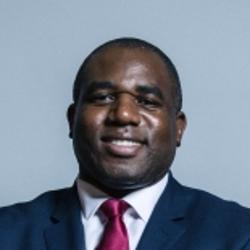
David Lammy
Labour - Tottenham
15,434 (38.4%) majority - 2024 General ElectionFirst elected: 22nd June 2000
22 Former APPG Officer Positions
Adult Education, Alevis, Betting Terminals, British Jews, Caribbean, Couple Relationships and Reducing Inter-Parental Conflict, Couple Relationships and Reducing Interparental Conflict, Crossrail Two, Faith and Society, Fatherhood, Fixed Odds Betting Terminals, Jews, Leasehold and Commonhold Reform, Leasehold Reform, London Stansted Cambridge Corridor, Parents and Families, Race and Community, Racism, Retail Crime, Social Integration, UK-EU Relations, Wellbeing EconomicsDivision Voting information
Debates during the 2024 Parliament
Speeches made during Parliamentary debates are recorded in Hansard. For ease of browsing we have grouped debates into individual, departmental and legislative categories.
Sparring Partners
(114 debate interactions)
(36 debate interactions)
(29 debate interactions)
Department Debates
(1102 debate contributions)
(520 debate contributions)
(25 debate contributions)
Legislation Debates
(3,692 words contributed)
(3,364 words contributed)
Tottenham Petitions
e-Petitions are administered by Parliament and allow members of the public to express support for a particular issue.
If an e-petition reaches 10,000 signatures the Government will issue a written response.
If an e-petition reaches 100,000 signatures the petition becomes eligible for a Parliamentary debate (usually Monday 4.30pm in Westminster Hall).
of 64,894 signatures (0.38%)
of 80,047 signatures (0.25%)
of 134,121 signatures (0.24%)
of 134,121 signatures (0.24%)
of 64,894 signatures (0.38%)
of 80,047 signatures (0.25%)
of 14,071 signatures (0.53%)
of 126,242 signatures (0.06%)
Latest EDMs signed by David Lammy
Godfrey Colin Cameron
Tabled by: Chris Stephens (Scottish National Party - Glasgow South West)That this House is deeply saddened by news of the death of Godfrey Colin Cameron, a hardworking member of Parliamentary security staff and member of the PCS trade union who passed away aged just 55 after contracting covid-19; extends our sincere condolences to his devoted wife Hyacinth, children Leon and …
(Most recent: 8 Feb 2021)
Signatures by party:
Labour: 112
Scottish National Party: 15
Independent: 6
Plaid Cymru: 3
Your Party: 1
Alba Party: 1
Democratic Unionist Party: 1
Enforcement
Tabled by: Keir Starmer (Labour - Holborn and St Pancras)That an humble Address be presented to Her Majesty, praying that the Taking Control of Goods and Certification of Enforcement Agents (Amendment) (No. 2) (Coronavirus) Regulations 2020 (S.I., 2020, No. 614), dated 19 June 2020, a copy of which was laid before this House on 19 June 2020, be annulled.
(Most recent: 15 Sep 2020)
Signatures by party:
Labour: 17
Independent: 1
Commons initiatives
These initiatives were driven by David Lammy, and are more likely to reflect personal policy preferences.
MPs who are act as Ministers or Shadow Ministers are generally restricted from performing Commons initiatives other than Urgent Questions.
David Lammy has not been granted any Urgent Questions
David Lammy has not been granted any Adjournment Debates
3 Bills introduced by David Lammy
A Bill to give effect to, and make provision in connection with, an agreement between the governments of the United Kingdom and the Republic of Mauritius concerning the Chagos Archipelago.
A Bill to Impose a duty on public authorities and public officials to act with candour, transparency and frankness; to make provision for the enforcement of that duty in their dealings with inquiries and investigations; to require public authorities to promote and take steps to maintain ethical conduct within all parts of the authority; to create an offence in relation to public authorities and public officials who mislead the public; to create further offences in relation to the misconduct of persons who hold public office and to abolish the common law offence of misconduct in public office; to make provision enabling persons to participate at inquiries and investigations where the conduct of public authorities may be in issue; and for connected purposes.
A Bill to Make provision in relation to criminal courts in England and Wales; to make provision about the leadership of tribunals; to amend section 1 of the Children Act 1989 to remove the presumption relating to the involvement of parents in the life of a child; and for connected purposes.
Tuesday 27th October 2026
Tuesday 10th November 2026
10 Bills co-sponsored by David Lammy
Victims of Crime and Anti-social Behaviour, Etc (Rights, Entitlements and Related Matters) Bill 2019-21
Sponsor - Peter Kyle (Lab)
Terms of Withdrawal from the EU (Referendum) (No. 2) Bill 2017-19
Sponsor - Geraint Davies (Ind)
European Union (Revocation of Notification of Withdrawal) Bill 2017-19
Sponsor - Geraint Davies (Ind)
Parental Leave and Pay Arrangements (Publication) Bill 2017-19
Sponsor - Jo Swinson (LD)
Immigration (Time Limit on Detention) Bill 2017-19
Sponsor - Tulip Siddiq (Lab)
Terms of Withdrawal from EU (Referendum) Bill 2017-19
Sponsor - Geraint Davies (Ind)
Mental Health Units (Use of Force) Act 2018
Sponsor - Steve Reed (LAB)
Online Forums Bill 2017-19
Sponsor - Lucy Powell (LAB)
Fire Safety Information Bill 2017-19
Sponsor - Maria Miller (Con)
Family Justice Bill 2016-17
Sponsor - None ()
Latest 9 Written Questions
(View all written questions)Funding for rare neurological conditions is determined through established National Health Service allocation, commissioning arrangements and the annual planning round, which usually takes into account population need and clinical priorities to determine the best available use of resources. For delegated services, integrated care boards determine how their allocations are used to meet local need, while NHS England retains responsibility for nationally commissioned highly specialised services.
NHS England commissions specialised service for children with complex neurological conditions, including neurogenetic conditions, such as alternating hemiplegia of childhood, and its service specification sets out a national, multidisciplinary models for assessment and care planning. The specification is available at the following link:
Parliamentary Under-Secretary (Department of Health and Social Care)
Funding for rare neurological conditions is determined through established National Health Service allocation, commissioning arrangements and the annual planning round, which usually takes into account population need and clinical priorities to determine the best available use of resources. For delegated services, integrated care boards determine how their allocations are used to meet local need, while NHS England retains responsibility for nationally commissioned highly specialised services.
NHS England commissions specialised service for children with complex neurological conditions, including neurogenetic conditions, such as alternating hemiplegia of childhood, and its service specification sets out a national, multidisciplinary models for assessment and care planning. The specification is available at the following link:
Parliamentary Under-Secretary (Department of Health and Social Care)
The UK supports the rights of all minority groups in Turkey, including Kurdish citizens, and consistently encourages Turkey to uphold the rule of law and to live up to its international obligations as a member of the Council of Europe.
Assistant Whip
A response to the letter of 16 September 2026 was dispatched 21 October 2026 under reference MPAM/1573185/26.
Parliamentary Under-Secretary (Home Office)
The Home Office publishes data on grants of Indefinite Leave to Remain (ILR, or settlement) in the Settlement data tables contained in the ‘Immigration system statistics data tables - GOV.UK’. In particular, detailed table SE_D02 identifies the ECAA route under previous category of leave. The latest data relates to the year ending June 2026. However, this table does not provide the requested breakdown of rejected applications, nor on those remaining contested, nor on processing times.
Table VSI_02 within the Migration Transparency - Visas status and immigration data tables contains applications received for ECAA Settlement, with the latest data covering the quarter ending March 2026.
Operational data also show that decision output is now substantially above average weekly intake, and that the number of outstanding applications has reduced considerably. The route remains on course to return to service standard shortly.
Parliamentary Under-Secretary (Home Office)
2 Ministry of Housing, Communities and Local Government Questions
(View all David Lammy's MHCLG questions)The Code of Practice for the Remediation of Residential Buildings has been developed with residents, industry, and government bodies to ensure that its expectations are appropriate and deliverable, and all remediation programmes are working to drive compliance. We continue to work across government and with industry bodies on supporting the Code’s implementation and we have launched a Resident Representative Survey to understand the resident experience of remediation, including with the Code of Practice, across all schemes.
We continue to consider the resident experience in remediation, and we will keep the Code of Practice under review. Where there are significant new or emerging developments, the Code will be updated.
Minister of State (Housing, Communities and Local Government)
The Code of Practice for the Remediation of Residential Buildings has been developed with residents, industry, and government bodies to ensure that its expectations are appropriate and deliverable, and all remediation programmes are working to drive compliance. We continue to work across government and with industry bodies on supporting the Code’s implementation and we have launched a Resident Representative Survey to understand the resident experience of remediation, including with the Code of Practice, across all schemes.
We continue to consider the resident experience in remediation, and we will keep the Code of Practice under review. Where there are significant new or emerging developments, the Code will be updated.
Minister of State (Housing, Communities and Local Government)