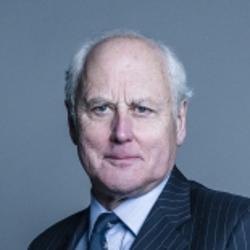
Lord Hodgson of Astley Abbotts
Conservative - Life peer
Joined House of Lords: 7th June 2000
Robin Hodgson was elected as an MP between 1976 and 1979.
Left House: 12th December 2025 (Retired)
5 APPG Memberships
Beer, Financial Education for Young People, Future of Work, Modern Conflict, University13 Former APPG Officer Positions
'Left Behind' Neighbourhoods, Building Communities, Charities and Volunteering, Civil Society and Volunteering, Drones, Drones and Modern Conflict, Extraordinary Rendition, Modern Conflict, Outdoor Recreation and Access to Nature, Penal Affairs, Restorative Justice, University, War HeritageDivision Voting information
Lord Hodgson of Astley Abbotts voted Aye - against a party majority and in line with the House
One of 4 Conservative Aye votes vs 224 Conservative No votes
Tally: Ayes - 299 Noes - 284
Lord Hodgson of Astley Abbotts voted Aye - against a party majority and in line with the House
One of 13 Conservative Aye votes vs 208 Conservative No votes
Tally: Ayes - 339 Noes - 235
Lord Hodgson of Astley Abbotts voted Aye - against a party majority and against the House
One of 9 Conservative Aye votes vs 198 Conservative No votes
Tally: Ayes - 57 Noes - 234
Lord Hodgson of Astley Abbotts voted Aye - against a party majority and in line with the House
One of 6 Conservative Aye votes vs 185 Conservative No votes
Tally: Ayes - 307 Noes - 212
Lord Hodgson of Astley Abbotts voted Aye - against a party majority and against the House
One of 7 Conservative Aye votes vs 194 Conservative No votes
Tally: Ayes - 130 Noes - 225
Lord Hodgson of Astley Abbotts voted Aye - against a party majority and against the House
One of 5 Conservative Aye votes vs 203 Conservative No votes
Tally: Ayes - 160 Noes - 241
Lord Hodgson of Astley Abbotts voted Aye - against a party majority and against the House
One of 7 Conservative Aye votes vs 191 Conservative No votes
Tally: Ayes - 155 Noes - 326
Lord Hodgson of Astley Abbotts voted No - against a party majority and in line with the House
One of 14 Conservative No votes vs 129 Conservative Aye votes
Tally: Ayes - 146 Noes - 260
Lord Hodgson of Astley Abbotts voted Aye - against a party majority and in line with the House
One of 1 Conservative Aye votes vs 106 Conservative No votes
Tally: Ayes - 172 Noes - 125
Lord Hodgson of Astley Abbotts voted No - against a party majority and in line with the House
One of 21 Conservative No votes vs 22 Conservative Aye votes
Tally: Ayes - 41 Noes - 124
Lord Hodgson of Astley Abbotts voted No - against a party majority and in line with the House
One of 37 Conservative No votes vs 41 Conservative Aye votes
Tally: Ayes - 107 Noes - 180
Lord Hodgson of Astley Abbotts voted Aye - against a party majority and against the House
One of 2 Conservative Aye votes vs 97 Conservative No votes
Tally: Ayes - 28 Noes - 148
Lord Hodgson of Astley Abbotts voted Aye - against a party majority and against the House
One of 50 Conservative Aye votes vs 50 Conservative No votes
Tally: Ayes - 103 Noes - 278
Lord Hodgson of Astley Abbotts voted Aye - against a party majority and against the House
One of 1 Conservative Aye votes vs 124 Conservative No votes
Tally: Ayes - 158 Noes - 174
Lord Hodgson of Astley Abbotts voted Aye - against a party majority and in line with the House
One of 2 Conservative Aye votes vs 133 Conservative No votes
Tally: Ayes - 273 Noes - 173
Lord Hodgson of Astley Abbotts voted Aye - against a party majority and in line with the House
One of 2 Conservative Aye votes vs 129 Conservative No votes
Tally: Ayes - 264 Noes - 159
Lord Hodgson of Astley Abbotts voted Aye - against a party majority and in line with the House
One of 3 Conservative Aye votes vs 128 Conservative No votes
Tally: Ayes - 247 Noes - 160
Lord Hodgson of Astley Abbotts voted Aye - against a party majority and against the House
One of 1 Conservative Aye votes vs 98 Conservative No votes
Tally: Ayes - 69 Noes - 123
Lord Hodgson of Astley Abbotts voted Aye - against a party majority and against the House
One of 24 Conservative Aye votes vs 65 Conservative No votes
Tally: Ayes - 72 Noes - 151
Lord Hodgson of Astley Abbotts voted Aye - against a party majority and in line with the House
One of 27 Conservative Aye votes vs 118 Conservative No votes
Tally: Ayes - 277 Noes - 215
Lord Hodgson of Astley Abbotts voted Aye - against a party majority and in line with the House
One of 10 Conservative Aye votes vs 117 Conservative No votes
Tally: Ayes - 219 Noes - 218
Lord Hodgson of Astley Abbotts voted Aye - against a party majority and in line with the House
One of 28 Conservative Aye votes vs 74 Conservative No votes
Tally: Ayes - 196 Noes - 122
Lord Hodgson of Astley Abbotts voted Aye - against a party majority and against the House
One of 16 Conservative Aye votes vs 77 Conservative No votes
Tally: Ayes - 141 Noes - 194
Lord Hodgson of Astley Abbotts voted Aye - against a party majority and against the House
One of 1 Conservative Aye votes vs 68 Conservative No votes
Tally: Ayes - 71 Noes - 210
Lord Hodgson of Astley Abbotts voted Aye - against a party majority and against the House
One of 3 Conservative Aye votes vs 37 Conservative No votes
Tally: Ayes - 57 Noes - 129
Lord Hodgson of Astley Abbotts voted Aye - against a party majority and in line with the House
One of 5 Conservative Aye votes vs 8 Conservative No votes
Tally: Ayes - 190 Noes - 16
Lord Hodgson of Astley Abbotts voted Aye - against a party majority and in line with the House
One of 7 Conservative Aye votes vs 58 Conservative No votes
Tally: Ayes - 148 Noes - 87
Lord Hodgson of Astley Abbotts voted Aye - against a party majority and against the House
One of 11 Conservative Aye votes vs 133 Conservative No votes
Tally: Ayes - 122 Noes - 326
Lord Hodgson of Astley Abbotts voted Aye - against a party majority and in line with the House
One of 1 Conservative Aye votes vs 209 Conservative No votes
Tally: Ayes - 303 Noes - 223
Lord Hodgson of Astley Abbotts voted Aye - against a party majority and in line with the House
One of 2 Conservative Aye votes vs 179 Conservative No votes
Tally: Ayes - 216 Noes - 195
Lord Hodgson of Astley Abbotts voted Aye - against a party majority and in line with the House
One of 2 Conservative Aye votes vs 179 Conservative No votes
Tally: Ayes - 216 Noes - 195
Lord Hodgson of Astley Abbotts voted Aye - against a party majority and against the House
One of 3 Conservative Aye votes vs 80 Conservative No votes
Tally: Ayes - 18 Noes - 81
Lord Hodgson of Astley Abbotts voted Aye - against a party majority and in line with the House
One of 1 Conservative Aye votes vs 75 Conservative No votes
Tally: Ayes - 83 Noes - 76
Lord Hodgson of Astley Abbotts voted Aye - against a party majority and in line with the House
One of 16 Conservative Aye votes vs 147 Conservative No votes
Tally: Ayes - 245 Noes - 154
Lord Hodgson of Astley Abbotts voted Aye - against a party majority and in line with the House
One of 11 Conservative Aye votes vs 146 Conservative No votes
Tally: Ayes - 222 Noes - 154
Lord Hodgson of Astley Abbotts voted Aye - against a party majority and in line with the House
One of 15 Conservative Aye votes vs 155 Conservative No votes
Tally: Ayes - 231 Noes - 167
Lord Hodgson of Astley Abbotts voted Aye - against a party majority and in line with the House
One of 7 Conservative Aye votes vs 136 Conservative No votes
Tally: Ayes - 177 Noes - 141
Lord Hodgson of Astley Abbotts voted Aye - against a party majority and in line with the House
One of 3 Conservative Aye votes vs 195 Conservative No votes
Tally: Ayes - 228 Noes - 213
Lord Hodgson of Astley Abbotts voted Aye - against a party majority and against the House
One of 33 Conservative Aye votes vs 39 Conservative No votes
Tally: Ayes - 83 Noes - 129
All Debates
Speeches made during Parliamentary debates are recorded in Hansard. For ease of browsing we have grouped debates into individual, departmental and legislative categories.
Sparring Partners
View All Sparring PartnersDepartment Debates
(143 debate contributions)
(122 debate contributions)
(117 debate contributions)
(52 debate contributions)
Legislation Debates
(11,816 words contributed)
(10,734 words contributed)
(10,082 words contributed)
(8,513 words contributed)
Lords initiatives
These initiatives were driven by Lord Hodgson of Astley Abbotts, and are more likely to reflect personal policy preferences.
1 Bill introduced by Lord Hodgson of Astley Abbotts
A Bill to establish the Office for Demographic Change with the duty of collecting evidence about and analysing the impact of population change, and considering future changes in the population of the United Kingdom and their consequences; and for connected purposes
Lord Hodgson of Astley Abbotts has not co-sponsored any Bills in the current parliamentary sitting
Latest 50 Written Questions
(View all written questions)2 Other Department Questions
The current level of Private Bill fees was agreed to by the House on 27 March 2000, and the consequent amendments to Private Business Standing Orders agreed to on 24 July 2000, following a recommendation of the Select Committee of House of Lords’ Offices (4th Report, Session 1999-2000, HL Paper 45). A review of private legislation fees charged to promoters and applicants, as set out in the Table of fees in Private Business Standing Orders, is planned to take place this year.
The Council for Mortgage Lenders advises that having a student loan will not affect a borrower’s eligibility to be considered for a mortgage.
Shadow Chief Whip (Lords)
The Charity Commission sought the previous Attorney General’s permission to refer a number of questions to the Tribunal concerning the Corporation of the Hall of Arts and Sciences – the Royal Albert Hall – which is a registered charity. While the Charity Commission has the power to refer questions to the Tribunal, it may only do so with the consent of the Attorney General, as set out in section 325 of the Charities Act 2011.
The issues concerned in this case are complex. The Attorney General’s Office (AGO) has engaged with the parties since the original request was made in order to explore the issues, which involve both modern charity law and its application to an organisation established over 150 years ago. This engagement has helped to refine the issues.
Before taking a decision on whether to consent to the latest iteration of the Commission’s request, the previous Attorney General asked the Commission and the Corporation to try to find a way forward without recourse to litigation. The AGO is awaiting an indication from the parties regarding the outcome of that process.
In December of last year, the Charity Commission wrote to the then Attorney General requesting consent to refer six questions to the First-Tier Tribunal concerning the Corporation of the Hall of Arts and Sciences, the Royal Albert Hall, which is a registered charity. This is the third such request by the Commission since 2017. The then Attorney General granted, then subsequently withdrew his consent in relation to the first request. The second request was withdrawn, with consent then sought for the reference of an amended set of questions last December. While the Charity Commission has the power to refer questions to the Tribunal, it may only do so with the consent of the Attorney General, as set out in section 325 of the Charities Act 2011.
The Corporation made further representations in relation to the Commission’s request earlier this year. The Attorney General is in the process of considering the request and representations with a view to issuing a decision in due course.
Shadow Minister (Justice)
Last year the Charity Commission wrote to the Attorney General requesting his consent to refer five questions to the First-Tier Tribunal concerning the Corporation of the Hall of Arts and Sciences – i.e. the Royal Albert Hall, which is a registered charity. While the Charity Commission has the power to refer questions to the Tribunal, it may only do so with the consent of the Attorney General, as set out in section 325 of the Charities Act 2011.
As set out in the Written Answer HL13508, this is a complex case and careful consideration is being given to the detailed representations made by the Corporation and the Commission. While it is not yet possible to provide an estimate as to when a final decision will be made, a preliminary response from officials is being drawn up setting out initial views and inviting further discussion between the parties. This will be sent to the Commission and the Corporation shortly.
Shadow Minister (Justice)
Last year the Charity Commission wrote to the Attorney General requesting his consent to refer five questions to the First-Tier Tribunal concerning the Corporation of the Hall of Arts and Sciences – i.e. the Royal Albert Hall, which is a registered charity. While the Charity Commission has the power to refer questions to the Tribunal, it may only do so with the consent of the Attorney General, as set out in section 325 of the Charities Act 2011.
This is a complex case involving the application of modern day charity law to an organisation established over 150 years ago. Before making an assessment as to whether consent should be given to the Commission’s request, both the Corporation and the Commission were invited to make further representations to the Attorney General’s Office. It is important that these are considered carefully, taking into account all relevant factors. While it is not possible to provide an exact estimate as to when a decision will be made, the matter is being given careful thought with a view to reaching a decision as soon as possible.
Shadow Minister (Justice)
The Attorney General has received a request from the Charity Commission to grant his consent to a reference to the Charity Commission on various points of law. The Attorney General requested further information from the Charity Commission and the Royal Albert Hall Corporation. He has now received that further information and expects to make a decision early this year.
Shadow Minister (Justice)
The Government understands that the Investigatory Powers Commissioner’s proposals for how the Consolidated Guidance could be improved should be submitted shortly. The Government will respond to those proposals in due course.
The Secretary of State for Housing, Communities, and Local Government is responsible for communities and integration and the Parliamentary Under-Secretary of State for Sport and Civil Society is responsible for the Office for Civil Society.
The information requested falls within the responsibility of the UK Statistics Authority. I have asked the Authority to reply.
Dear Lord Hodgson,
As National Statistician and Chief Executive of the UK Statistics Authority, I am replying to your Parliamentary Question asking what assessment has been made of the difference between (1) the number of National Insurance numbers issued to non-UK nationals, and (2) total immigration to the UK in the last five years (HL12534).
The Office for National Statistics (ONS) publishes migration statistics and in 2016, looked at the differences between long term international migration (LTIM) figures and the allocation of national insurance numbers (NINos) to EU nationals and published papers about their findings[1]and the next steps[2].
The LTIM estimates produced by ONS are in line with the United Nations definition of a long-term migrant; intending to stay for at least 12 months. NINos are issued to people who come to the UK to work or look for work, regardless of the length of stay. NINos may therefore include short-term migrants (those entering the UK for less than 12 months) who will not be included in LTIM estimates. LTIM estimates will include people (such as students) who come to the UK for reasons other than work and don’t register for a NINo, so are not included in NINo data.
Further publications about improving the evidence[3] and the migration statistics transformation programme[4] include further information about how ONS is developing the evidence base on migration. Understanding the differences between data sources is an important part of our analysis within that programme and ONS will report further in due course.
Yours sincerely,
John Pullinger
The information requested falls within the responsibility of the UK Statistics Authority. I have asked the Authority to reply and I will place a copy of their letter in the Library of the House.
The information requested falls within the responsibility of the UK Statistics Authority. I have asked the Authority to reply.
8 Department for Business, Energy and Industrial Strategy Questions
(View all Lord Hodgson of Astley Abbotts's BEIS questions)This Government understands that good management of risk is essential for contingency planning, increasing the likelihood that the services we rely on day-to-day are available for citizens and ensuring that we can protect people’s health and safety.
The Department is the Lead Government Department for the risk of a severe space weather event. BEIS is therefore responsible for coordinating a Cross-Government work programme to ensure that appropriate preparedness and mitigation measures are in place so that impacts from severe space weather are minimised. BEIS working closely with the Met Office, Civil Contingencies Secretariat, other Government Departments, and academic partners has taken significant steps to increase the UK’s preparedness for major space weather events.
The Department will publish a new space weather strategy later this year, which will set out a five-year road map for how we intend to boost resilience and build on existing UK strength and capacity in this area, to continue to increase our preparedness for a severe space weather event.
Shadow Minister (Foreign, Commonwealth and Development Office)
The Government will publish a report in due course of its review of the voluntary measures that were introduced in 2015 to enhance regulation of pre-pack administrations. The report will set out the Government’s plans for the future of pre-pack administrations.
Shadow Minister (Foreign, Commonwealth and Development Office)
The Government is committed to acting on the findings of the three independent reviews of audit: the FRC review, the CMA review and the Brydon review, covering respectively the regulator, the market and the audit product itself. We will set out comprehensive proposals for audit reform in the Spring and will then bring forward legislation as soon as parliamentary time allows.
Shadow Minister (Foreign, Commonwealth and Development Office)
The Companies Act (2006) requires companies to keep a register of members and enter the details of members in this register. In the UK, a shareholder is defined as the member on the company’s register of members. In some cases, the shareholder is also the beneficial owner of the shares. The Government has no plans to require beneficial share owners to be included on shareholder registers.
The Companies Act 2006 already requires companies to keep their register of members up to date. Companies whose shares are not traded must file the names of their members on the public companies register held at Companies House. Companies whose shares are traded must file the name and address of shareholders who hold 5% or more of any class of issued shares.
The Consumer Rights Act enhances consumers’ ability to seek full compensation for any detriment suffered as a result of a breach of competition Law. Schedule 8 of the Act amended the Competition Act 1998, expanding the jurisdiction of the Competition Appeal Tribunal (CAT), to hear standalone actions (powers akin to those of the High Court) and to hear collective proceedings.
A case was filed against Mastercard at the CAT in September this year (by representative Walter Merricks) on behalf of up to 40 million consumers, which is still in its early stages. It is the first claim of its sort, for a potential £14 billion pounds, brought on behalf of all UK consumers who have suffered loss, following the long-running European Commission case that ended in 2014 and the Commission’s decision that Mastercard had infringed EU competition law. Developments in the case can be followed through the CAT website.
It would be premature to undertake a consultation on the Act’s impact at present. The Government is required to carry out a full review, consulting a wide variety of stakeholders, including consumer groups, once the Act has been in force for five years.
The Government intends to publish a discussion paper on options for improving corporate governance before the end of the year.
Shadow Minister (Treasury)
12 Department for Digital, Culture, Media & Sport Questions
(View all Lord Hodgson of Astley Abbotts's DCMS questions)The Listed Places of Worship Grant Scheme (LPWGS) was established in 2001 to provide grants towards VAT paid on repairs and maintenance to the nation's listed churches and cathedrals. The scheme, which presently handles around 7000 claims per annum, applies to all faiths and denominations and is delivered UK wide. It is currently funded through a combination of £17 million from the Department for Culture, Media and Sport’s core baseline, together with £25 million available from HMT reserves (so a total of up to £42m total each financial year).
Historically, the scheme has operated with an underspend each year. However, efforts are underway to reduce underspend, including via a new LPWGS website and comms outreach campaign. Initial data since the launch of the website in July 2023 suggests a gradual increase in uptake and grants being made.
The LPWGS website provides details of the annual spend of the scheme, but does not provide details of previous years’ allocations. See here: https://listed-places-of-worship-grant.dcms.gov.uk/about-us/.
Shadow Minister (Digital, Culture, Media and Sport)
Listed places of worship represent some of the nation's finest heritage, and HM Government recognises the need to preserve and maintain such hallowed buildings. The Listed Place of Worship Grant Scheme aims to mitigate the cost of doing so and to support listed and protected buildings for the benefit of present and future generations.
There are presently no plans to amend the eligibility criteria for the scheme, but we keep them under review. We have also been working to ensure that the accessibility and uptake of the scheme is improved, particularly through the development of a new website and application process. Officials maintain regular contact with key people and organisations representing listed places of worship, and continue to welcome feedback on the operation and effectiveness of the scheme. I was pleased to visit St Peter and St Paul's church in Albury, Surrey, earlier this year to hear how the Listed Places of Worship grant scheme helped them to carry out repairs to the church roof.
Shadow Minister (Digital, Culture, Media and Sport)
His Majesty’s Government has recently announced that community wealth funds will become the fourth cause for dormant assets funding in England.
A community wealth fund will provide funding sources to local communities, with spending decisions made by local residents about how to improve their communities. The Government will soon launch a technical consultation on the design of this important new initiative and welcomes views on how best to ensure its long-term impact; the consultation will be open for 12 weeks.
Secondary legislation to enable dormant assets funding to be directed to community wealth funds will be introduced as soon as Parliamentary time allows.
Shadow Minister (Digital, Culture, Media and Sport)
As with all public authorities, the Charity Commission works in accordance with the Freedom of Information Act 2000 and releases requested information unless there is good reason not to.
The Charity Commission responds to requests under the Freedom of Information Act 2000 on a case-by-case basis. It can refuse to disclose information if, for example, under Section 31 of the Freedom of Information Act 2000, it would be prejudicial to the Charity Commission’s functions and not in the public interest to disclose.
An internal review procedure is available in cases where the Charity Commission has refused to disclose information under the Freedom of Information Act 2000. If the individual requesting the information remains dissatisfied with the Charity Commission’s final decision they can make a complaint to the Information Commissioner.
The Charity Commission has published policies setting out when it will publish an inquiry or operational case report. The Charity Commission has discretion about what to include in these reports. It is not practical to publish details each time the Charity Commission opens compliance cases, statutory inquiries or uses its powers, including issuing advice or guidance.
The Charity Commission reports on its work broadly and on a thematic basis, including an annual report on its work dealing with wrongdoing and harm. These reports explain the commission’s approach to investigations and compliance case work. They give details of the volume and nature of cases dealt with in a given year and include case study examples.
All of the Charity Commission’s general advice for trustees, to give them the tools and understanding they need to succeed, is published and available on gov.uk.
The Law Commission expects to publish its report on technical issues in charity law, together with a draft bill, this summer. The Government will need to consider the report and its recommendations carefully.
Under s51(3) of the Data Protection Act 1998 the Information Commissioner is required to consult 'with trade associations, data subjects or persons representing data subjects as appears to him to be appropriate' before preparing and publishing Codes of Practice or guidance.
The Information Commissioner regularly consults on new guidance and codes of practice – for example the recent Privacy Notices code of practice. Details of ICO consultations can be found on the ICO website www.ico.org.uk. The Information Commissioner will review the way in which the ICO consults and prepares guidance as part of its preparations to implement the EU General Data Protection Regulation. A consultation will also be held in relation to the statutory Code of Practice on direct marketing when the provisions in the Digital Economy Bill become law.
The ICO has met with the new Fundraising regulator and the Charity Commission, where the guidance on direct marketing has been discussed and promoted. A Memorandum of Understanding between the Information Commissioner's Office and the Fundraising Regulator has been recently agreed. The ICO have also spoken at a number of conferences for the third sector to promote the guidance.
Under s51 of the Data Protection Act 1998 the Information Commissioner has a duty to promote the following of good practice by data controllers. The ICO updated its direct marketing guidance in March 2016, which included examples and references to the charitable sector, and published a webinar on its website which provided specific advice to charities on how to comply with the direct marketing legislation. In addition, the ICO published its updated Privacy Notices Code in October 2016, a checklist for all organisations buying and selling data, including those undertaking direct marketing. All guidance can be found on the ICO's website www.ico.org.uk
I refer the noble Lord Hodgson of Astley Abbotts to the answer I gave on 25 April 2022 to question HL7809.
The government has now responded to the recommendations outlined within ‘The Ties that Bind: Citizenship and Civic Engagement in the 21st Century Follow-up report’, including the recommendations relating to the inspection of citizenship education.
Ofsted, as a separate government department and independent inspectorate, is responsible for the criteria in its inspection framework and handbooks.
On 21 February, Ofsted wrote to the Chair of the House of Lords Liaison Committee, Lord Gardiner of Kimble, setting out its inspection approach regarding citizenship education. The letter is available at: https://committees.parliament.uk/publications/9100/documents/159384/default/.
The department has subsequently discussed this matter with Her Majesty’s Chief Inspector, Amanda Spielman. The Chief Inspector has confirmed that citizenship education forms a significant, but proportionate, part of school inspections. There are no plans to publish correspondence or minutes relating to discussions on this matter. The government will respond in due course to ‘The Ties that Bind: Citizenship and Civic Engagement in the 21st Century Follow-up report’, which includes recommendations relating to the inspection of citizenship education.
The number of teachers in state funded secondary schools in England, who are recorded as teaching one or more lessons of citizenship per week, are shown in the table below. The latest information gives the situation in November 2019. Information for November 2020 will be published in June 2021. Information for 2021 will be collected via the School Workforce Census later this year.
As at November 2019 | 2016 | 2017 | 2018 | 2019 |
Headcount of teachers teaching citizenship | 4,826 | 4,451 | 4,241 | 4,257 |
As a % of all teachers in state funded secondary schools | 2.2% | 2.0% | 1.9% | 1.9% |
The majority of teachers of citizenship also teach other subjects.
The number of trainees who successfully completed training in citizenship education from the 2015/16 to the 2018/19 academic year inclusive is summarised in the table below:
Academic Year | 2015/16 | 2016/17 | 2017/18 | 2018/19 |
Postgraduate trainees awarded qualified teacher status | 78 | 45 | 37 | 31 |
The data on numbers of postgraduate trainees awarded qualified teacher status, for the academic years 2019/20 and 2020/21 is not yet available. Due to a change in the recording of subjects in the Initial Teacher Training data, we will not be able to specifically identify Citizenship trainees for the academic year 2019/2020 onwards.
The number of teachers in state funded secondary schools in England, who are recorded as teaching one or more lessons of citizenship per week, are shown in the table below. The latest information gives the situation in November 2019. Information for November 2020 will be published in June 2021. Information for 2021 will be collected via the School Workforce Census later this year.
As at November 2019 | 2016 | 2017 | 2018 | 2019 |
Headcount of teachers teaching citizenship | 4,826 | 4,451 | 4,241 | 4,257 |
As a % of all teachers in state funded secondary schools | 2.2% | 2.0% | 1.9% | 1.9% |
The majority of teachers of citizenship also teach other subjects.
The number of trainees who successfully completed training in citizenship education from the 2015/16 to the 2018/19 academic year inclusive is summarised in the table below:
Academic Year | 2015/16 | 2016/17 | 2017/18 | 2018/19 |
Postgraduate trainees awarded qualified teacher status | 78 | 45 | 37 | 31 |
The data on numbers of postgraduate trainees awarded qualified teacher status, for the academic years 2019/20 and 2020/21 is not yet available. Due to a change in the recording of subjects in the Initial Teacher Training data, we will not be able to specifically identify Citizenship trainees for the academic year 2019/2020 onwards.
Information on the destinations of students 6 months after leaving UK higher education is collected and published by the Higher Education Statistics Agency (HESA) as part of the Destination of Leavers from Higher Education (DLHE) survey.
Latest statistics were published in June 2018 for students leaving their courses in the 2016/17 academic year, and are available at the following link:
https://www.hesa.ac.uk/news/28-06-2018/sfr250-higher-education-leaver-statistics.
As part of the DLHE survey, HESA records the Standard Occupation Classification category of those respondents who were in employment. Of the UK and EU-domiciled leavers from undergraduate courses in engineering who responded to the survey, and were in employment 6 months after graduating, 49.8% were estimated to be employed in roles categorised as ‘engineering professionals’.
The share of engineering leavers employed as ‘engineering professionals’ varies across engineering subjects. For that reason, a more detailed subject breakdown has been provided in the table.
Share of engineering leavers1 in engineering occupations2 six months after graduation
UK higher education institutions
2016/17 leavers
Engineering subject | Count3 of survey respondents in employment | Share of survey respondents employed as ‘engineering professionals’ |
General engineering | 1,220 | 45.8% |
Civil engineering | 1,860 | 68.0% |
Mechanical engineering | 3,520 | 57.1% |
Aerospace engineering | 950 | 34.8% |
Naval architecture | 40 | 58.5% |
Electronic & electrical engineering | 2,475 | 39.3% |
Production & manufacturing engineering | 445 | 39.9% |
Chemical, process & energy engineering | 885 | 38.3% |
Others in engineering | 45 | 37.4% |
Total Engineering | 11,450 | 49.8% |
Source: DfE Analysis of the Higher Education Statistics Agency (HESA) Destinations of Leavers from Higher Education (DLHE) survey
1. Graduates in engineering-based subjects have been defined using the principal categories H1 to H9 of the Joint Academic Coding System (JACS). More information on JACS codes can be found at the following link: https://www.hesa.ac.uk/support/documentation/jacs.
2. Graduates categorised as being in Standard Occupational Classification (SOC) group 212 are considered to be in the ‘Engineering Professionals’ category. More information on SOC DLHE codes can be found at the following link: https://www.hesa.ac.uk/support/documentation/occupational/soc2010.
3. Counts are on the basis of full-person-equivalents. Where a student is studying more than one subject, they are apportioned between the subjects that make up their course.
4. Figures are rounded to the nearest 5.
Statistics about students leaving courses in the 2017/18 academic year will be published from HESA’s new Graduate Outcomes survey in April 2020. A key difference with this new survey is that employment activities will be measured 15 months after graduation, rather than after 6 months.
All state schools must offer a curriculum that is broad and balanced and that prepares pupils for the opportunities and responsibilities of later life. The department does not, however, stipulate how schools should organise themselves to best deliver their curriculum.
Schools have a duty to support the spiritual, moral, social and cultural development of pupils and support the promotion of fundamental British values. Ofsted is currently consulting on proposals for a new inspection framework that has a strong emphasis on schools providing a broad and balanced curriculum for all their pupils.
Citizenship is in the national curriculum at key stages 3 and 4 and provides pupils with knowledge, skills and understanding to prepare them to be informed, active and engaged citizens. The citizenship programme of study, introduced in September 2014, allows schools the freedom to use their professional judgement and an understanding of their pupils to develop the right approach for teaching in their schools.
Personal, social, health and economic education is a non-statutory subject in maintained schools although most schools teach it. Whilst it is not part of the national curriculum, schools are encouraged to teach it as part of their duty to provide a broad and balanced curriculum. It is compulsory in independent schools.
The government is making relationships education compulsory in all primary schools, relationships and sex education compulsory in all secondary schools and health education compulsory in all state-funded schools. We recently consulted on draft guidance for these subjects and this included a statement to note that these new subjects should complement, rather than duplicate, what is already taught through the national curriculum. We expect to lay the regulations, and accompanying draft guidance, in spring 2019 for debate and vote in Parliament.
Following the government’s commitment, set out in our response to the Lords Select Committee report ‘The Ties that Bind: Citizenship and Civic Engagement in the 21st Century’, the introduction of specialist leaders of education in citizenship was announced earlier this month.
The department does not make assessments of the methods employed by schools to teach English. Schools are free to decide on the most appropriate teaching methods and practices, depending on their pupils’ needs. We strongly encourage them to use teaching methods based on sound evidence. For example, the Education Endowment Foundation publishes robust evidence on effective pedagogic practice, for example its Teaching and Learning Toolkit, which is used by around 6 out of 10 teachers in senior leadership positions when deciding which approaches to adopt to improve teaching.
When it comes to the teaching of reading, the national curriculum requires the systematic teaching of phonics. There is a significant body of evidence that demonstrates that systematic phonics is a highly effective method for teaching early reading. The department has invested £26 million in a national network of English hubs to support local schools in developing their teaching practice, with a focus on systematic phonics. We are also funding 6 Phonics Partnerships and a series of Phonics Roadshows, to spread good practice and improve phonics teaching.
The annual Initial Teacher Training Census provides data on the number of trainee teachers recruited each year in which citizenship trainees are included in the ‘Other’ subject category.[1]
Analysis of the underlying data shows that in the academic year 2018/19, 37 postgraduate trainees began training in citizenship.[2]
[1] Of the 385 trainees included in the ‘Other’ subject category some are listed as belonging to a particular subject such as citizenship, dance or economics in the underlying data. Out of these trainees, 146 do not belong to any of the available subject categories and are listed as other in the underlying data, it is not known if any of these are citizenship trainees.
[2] Figures for 2018/19 are provisional and subject to change. Data were extracted on 19 November 2018.
6 Department for Environment, Food and Rural Affairs Questions
(View all Lord Hodgson of Astley Abbotts's Defra questions)This Government is supportive of the provision within section 147ZA of the 1980 Act that enables an authority to work with landowners and relevant parties to replace or improve existing structures so that they can be used more easily by individuals that may experience mobility challenges. There is currently no national assessment available of the impacts of this provision. However, we will continue to improve access to green and blue spaces, ensuring that it is safe and appropriate for all users, through our various initiatives.
Parliamentary Under-Secretary (Department for Environment, Food and Rural Affairs)
The Government is pleased to commit to progress in ensuring everyone should live within a 15-minute walk of a green or blue space. We have recently published for the first time green and blue space interim statistics and will continue to mature the metric and map the status.
As part of our work to improve public access to nature, we are also progressing plans to deliver nine new National River Walks across England, one in each region, to enhance access to nature. We will announce further details on this in due course.
Our new national forests will support delivery of environmental improvement goals including improving access to green space and better connecting people with nature. The ‘Western Forest’ will see 20 million trees planted across the West of England over the coming years and serve over 2.5 million residents, bringing trees and woodlands closer to where people live.
The second new national forest will be in the Oxford-Cambridge corridor, and a competition will be launched for a third new national forest in the Midlands or North of England in early 2026.
Parliamentary Under-Secretary (Department for Environment, Food and Rural Affairs)
Our nine new river walks and three new national forests will both increase available natural space and make it more accessible.
We are progressing plans to deliver nine new National River Walks across England, one in each region, to enhance access to nature and are currently considering several delivery options. Further details will be announced in due course.
Our three new national forests in the West of England, the Oxford-Cambridge corridor and the Midlands or North of England, once confirmed, will support delivery of environmental improvement goals including improving access to green space and better connecting people with nature. The Government will set out plans for new national forests in the coming months which will incorporate many factors, including a consideration of new permanent legal rights of access.
Parliamentary Under-Secretary (Department for Environment, Food and Rural Affairs)
Farmers are defined here as full time and part time principal farmers, business partners, directors and spouses. All other agricultural workers are defined here as regular employees, salaried managers and casual workers who were working on the holding on 1 June 2023.
Agricultural workforce in England in 2023
| 2023 |
|
Farmers | 178,696 |
|
All other agricultural workers | 113,705 |
|
Total agricultural workforce | 292,401 |
|
Notes
(a) Commercial holdings are those registered with the Rural Payments Agency for payments or livestock purposes and with significant levels of farming activity (as recorded in responses to the Defra June Survey of Agriculture or the Cattle Tracing System). Holdings are only included if they have more than five hectares of agricultural land, one hectare of orchards, 0.5 hectares of vegetables or 0.1 hectares of protected crops, or more than 10 cows, 50 pigs, 20 sheep, 20 goats or 1,000 poultry.
Full data series for agricultural workforce are published here for England. A copy is attached to this answer.
Similar figures for the UK are available at gov.uk.
The information requested is not held centrally and to obtain it would incur disproportionate costs.
Defra’s Grants Hub data does not hold a ‘Farming & Horticulture’ flag so it would not be possible to quickly pull together a list of schemes in scope of this question.
Manually reviewing the schemes and deciding if they fit or not, without a standard definition of what counts as ‘Farming & Horticulture’, would require a degree of personal judgement and therefore yield some inaccuracy. It would then be necessary to validate the list with teams to ensure they are ‘Farming & Horticulture’ grants.
From experience of similar requests, this would push the cost to disproportionate (ie greater than the HMT-set limit of £850 for a PQ answer).