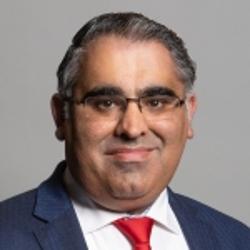
Tahir Ali
Labour - Birmingham Hall Green and Moseley
5,656 (13.6%) majority - 2024 General ElectionFirst elected: 12th December 2019
5 APPG Officer Positions (as of 12 Oct 2026)
Kashmir, Kuwait, Oman, Türkiye, Yemen4 APPG Memberships
Bosnia and Herzegovina, Republic of Korea, Boxing, Sustainable Plastics17 Former APPG Officer Positions
Bangladesh, Boxing, Britain-Pakistan Trade and Tourism, British Muslims, Civil Service and Public Sector Workers, Equality, Diversity and Inclusivity Professionals, Hajj and Umrah, Iraq, Italy, Jordan, Muslim Women, Pakistan, Palestine, Post Offices, Qatar, Saudi Arabia, TurkeyDivision Voting information
Tahir Ali voted No - against a party majority and against the House
One of 25 Labour No votes vs 291 Labour Aye votes
Tally: Ayes - 379 Noes - 137
Tahir Ali voted No - against a party majority and against the House
One of 9 Labour No votes vs 276 Labour Aye votes
Tally: Ayes - 385 Noes - 26
Debates during the 2024 Parliament
Speeches made during Parliamentary debates are recorded in Hansard. For ease of browsing we have grouped debates into individual, departmental and legislative categories.
Sparring Partners
Minister of State (Cabinet Office) (Jointly with the Foreign, Commonwealth and Development Office)
(17 debate interactions)
(6 debate interactions)
(6 debate interactions)
Department Debates
(40 debate contributions)
(6 debate contributions)
(4 debate contributions)
(4 debate contributions)
Legislation Debates
Tahir Ali has not made any spoken contributions to legislative debateBirmingham Hall Green and Moseley Petitions
e-Petitions are administered by Parliament and allow members of the public to express support for a particular issue.
If an e-petition reaches 10,000 signatures the Government will issue a written response.
If an e-petition reaches 100,000 signatures the petition becomes eligible for a Parliamentary debate (usually Monday 4.30pm in Westminster Hall).
of 20,535 signatures (2.57%)
of 129,579 signatures (0.15%)
of 20,535 signatures (2.57%)
of 129,579 signatures (0.15%)
of 20,710 signatures (0.47%)
of 71,844 signatures (0.11%)
Petition Closed
Call a public inquiry into pro-Israel influence on politics & democracy
Gov Responded - 17 Apr 2026 Debated on - 22 Jun 2026 View Tahir Ali's petition debate contributionsclosed 2 months, 2 weeks ago
We are concerned about reported Israeli state-linked and pro-Israel lobbying activity in UK politics. We believe it is important to determine the scope and impact of any such influence campaigns.
Petition Closed
Urgently fulfil humanitarian obligations to Gaza
Gov Responded - 8 Aug 2025 Debated on - 24 Nov 2025 View Tahir Ali's petition debate contributionsclosed 1 year, 2 months ago
Act to ensure deliverer of fuel, food, aid, life saving services etc. We think this shouldn't be dependant/on condition of Israeli facilitation as the Knesset voted against UNWRA access to Gaza. We think if military delivery of aid, airdrops, peacekeepers etc, are needed, then all be considered.
Petition Closed
Retain legal right to assessment and support in education for children with SEND
Gov Responded - 5 Aug 2025 Debated on - 15 Sep 2025 View Tahir Ali's petition debate contributionsclosed 1 year ago
Support in education is a vital legal right of children with special educational needs and disabilities (SEND). We ask the government to commit to maintaining the existing law, so that vulnerable children with SEND can access education and achieve their potential.
Latest EDMs signed by Tahir Ali
Taxation of bank windfall profits
Tabled by: Richard Burgon (Labour - Leeds East)That this House notes that major banks have made tens of billions of pounds in additional profits as interest rates have increased in recent years; further notes that this has happened while millions of people struggle with higher mortgage payments and rents and a wider cost-of-living crisis; also notes analysis …
(Most recent: 14 Oct 2026)
Signatures by party:
Labour: 23
Green Party: 5
Your Party: 2
Independent: 2
Alliance: 1
Democratic Unionist Party: 1
Social Democratic & Labour Party: 1
Technology companies and crimes against Palestinians
Tabled by: Apsana Begum (Labour - Poplar and Limehouse)That this House notes growing calls to end contracts with companies such as Palantir, Cisco and Oracle which are supplying technology used by Israel in its crimes against Palestinians; further notes that such technologies for mass surveillance enable arbitrary arrest and rights abuses against Palestinians in detention, and that technologies …
(Most recent: 2 Sep 2026)
Signatures by party:
Labour: 28
Scottish National Party: 5
Green Party: 5
Independent: 4
Plaid Cymru: 4
Your Party: 2
Liberal Democrat: 1
Commons initiatives
These initiatives were driven by Tahir Ali, and are more likely to reflect personal policy preferences.
MPs who are act as Ministers or Shadow Ministers are generally restricted from performing Commons initiatives other than Urgent Questions.
Tahir Ali has not been granted any Urgent Questions
Tahir Ali has not been granted any Adjournment Debates
Tahir Ali has not introduced any legislation before Parliament
Tahir Ali has not co-sponsored any Bills in the current parliamentary sitting
Latest 12 Written Questions
(View all written questions)United Kingdom Security Vetting (UKSV) provides a range of independent vetting services designed to identify potential personnel security risks. Accountability for individual appointments and the management of associated vetting risks remains with the relevant department. To ensure the continued effectiveness and integrity of the vetting process, on the 20th of April the Prime Minister requested a short review led by Sir Adrian Fulford provide recommendations on the lessons for the National Security Vetting (NSV) system from the Peter Mandelson case, and the policy, process and exemptions in place for NSV.
It is long-standing practice that we do not comment on confidential details in individual vetting cases.
Minister of State (Home Office) (Security) (Jointly with the Cabinet Office)
Minister of State (Home Office) (Security) (Jointly with the Cabinet Office)
The government set out its planned reforms to the special educational needs and disabilities system in the Schools White Paper published on 23 February 2026 here: https://www.gov.uk/government/publications/every-child-achieving-and-thriving.
Further details on the distribution of that funding will be published in the due course.
Minister of State (Education)
The Department for Transport continues to assess the safety impacts of e‑scooters through the rental trials and will share these findings in due course. All vehicles carry inherent safety risks, and we have taken a safety‑first approach by running controlled trials before permitting widespread use.
The second national evaluation of the trials, due to conclude this summer, will provide an updated casualty rate and further evidence to inform decisions on future regulation. The Department of Health and Social Care contributes a public health perspective to this work, including consideration of injury prevention and health impacts.
In the meantime, private e‑scooters remain illegal for use on public roads, and enforcement is a matter for the Police.
As part of NHS England’s assessment process, eligible National Health Service trusts and foundation trusts which apply for the Advanced Foundation Trust Programme will need to demonstrate effective mechanisms to engage meaningfully with patients, staff, and communities, and that involvement influences decisions.
The removal of councils of governors from NHS foundation trusts forms part of the wider aim of the 10-Year Health Plan to ensure that hospitals put patient experiences and outcomes at the heart of their decision-making. While governors have provided helpful advice and oversight for some foundation trusts, we now need to move to a more dynamic model of drawing on patient, staff, and stakeholder insight.
Minister of State (Department of Health and Social Care)
I refer the Hon Member to the answer provided on 27 April in response to Question 124946.
Minister of State (Cabinet Office) (Jointly with the Foreign, Commonwealth and Development Office)
I refer the Hon. Member to the statement made to the House by the Prime Minister on 13 April, in which he discussed the situation in Lebanon, and the Foreign Secretary's press statement on 17 April. The UK is supporting the ceasefire and continued direct talks between the governments of Lebanon and Israel as the best path to deliver lasting peace and security for both countries. We will provide further updates to the House in due course as the situation develops.
Minister of State (Cabinet Office) (Jointly with the Foreign, Commonwealth and Development Office)
I refer the Hon Member to the answers that the Foreign Secretary and I provided on these issues at departmental oral questions on 20 January, and the statement I made to the House on the Middle East on 5 January. We will continue to update the House on these issues on a similarly regular basis over the weeks and months to come.
Minister of State (Cabinet Office) (Jointly with the Foreign, Commonwealth and Development Office)
I refer the Hon Member to the answers that the Foreign Secretary and I provided on these issues at departmental oral questions on 20 January, and the statement I made to the House on the Middle East on 5 January. We will continue to update the House on these issues on a similarly regular basis over the weeks and months to come.
Minister of State (Cabinet Office) (Jointly with the Foreign, Commonwealth and Development Office)
Officials from all relevant Whitehall departments are exploring avenues to ensure our support best meets the needs of the critically ill in Gaza, including children, and we continue to support the provision of healthcare in Gaza and the region. The Government is keeping our humanitarian programme and existing policies on medical evacuations and visa pathways under review in response to events in Gaza.
We have announced £1 million for the Egyptian Ministry of Health and Population, delivered through World Health Organisation (WHO) Egypt, to support medically evacuated Palestinians from Gaza. The UK is also supporting the provision of essential healthcare to civilians in Gaza, including support to UK-MED who have now provided vital care to over 330,000 Gazans since the start of the conflict.
Minister of State (Cabinet Office) (Jointly with the Foreign, Commonwealth and Development Office)
Operational independence is a fundamental principle of British policing, and this Government is committed to ensuring the police can perform their role without fear or favour. At the same time, being able to scrutinise police decisions, and Chief Constables being able to account for the decisions they make, are essential especially when it comes to issues with clear implications for public safety and confidence
The Government’s recently published White Paper ‘From Local to National: A New Model for Policing’ announced plans to fundamentally reform the Policing Protocol Order 2023 and clarify the boundaries of operational independence to provide policing with direction and support to drive improvement where necessary.
Police officers take an oath of attestation on appointment which underscores the importance of policing with impartiality. They are required to act with impartiality, in accordance with their statutory standards of professional behaviour. The College of Policing sets standards and provides guidance for policing, including an updated Code of Ethics published in 2024 to support everyone in policing to act in a professional manner, reiterating the need for fairness and impartiality. Failure to act in accordance with relevant standards and guidance could result in formal disciplinary action being taken.
Minister of State (Home Office)
The humanitarian situation in Gaza remains extremely challenging. The UK committed £129 million in the last financial year, including £41 million for UNRWA. This supports vital infrastructure and ensures that those most in need across the Occupied Palestinian Territories, as well as those in neighbouring countries, are able to access healthcare, shelter and food assistance.
In any humanitarian situation, the UK must carefully consider its approach in response. Any decision to implement a bespoke visa scheme would need to consider a range of factors, including assessing the unique crisis and relevant impacts on security, compliance and returns.
The Government is working with the Israeli, Jordanian and Egyptian authorities to identify safe routes for British nationals and other eligible people to leave Gaza. Palestinians who wish to settle in the UK can do so via the existing routes available which allow a person to apply to work, study, settle or join family in the UK. Further information can be found on the GOV.UK website: UK Visas and Immigration - GOV.UK.