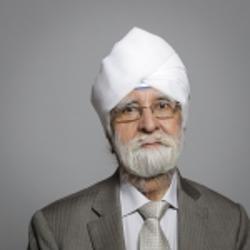
Lord Suri
Conservative - Life peer
Joined House of Lords: 11th September 2014
Left House: 9th March 2026 (Retired)
7 Former APPG Officer Positions
British Sikhs, Durham University, Indian Traditional Sciences, International Freedom of Religion or Belief, Religion or Belief, Sikhs, Western Rail Link to HeathrowDivision Voting information
Lord Suri voted No - against a party majority and against the House
One of 12 Conservative No votes vs 147 Conservative Aye votes
Tally: Ayes - 408 Noes - 24
Lord Suri voted No - against a party majority and against the House
One of 7 Conservative No votes vs 108 Conservative Aye votes
Tally: Ayes - 128 Noes - 124
Lord Suri voted Aye - against a party majority and against the House
One of 6 Conservative Aye votes vs 131 Conservative No votes
Tally: Ayes - 125 Noes - 162
All Debates
Speeches made during Parliamentary debates are recorded in Hansard. For ease of browsing we have grouped debates into individual, departmental and legislative categories.
Sparring Partners
(7 debate interactions)
Shadow Minister (Foreign, Commonwealth and Development Office)
(4 debate interactions)
Department Debates
(12 debate contributions)
(12 debate contributions)
(12 debate contributions)
(9 debate contributions)
Legislation Debates
(599 words contributed)
(401 words contributed)
(86 words contributed)
Lords initiatives
These initiatives were driven by Lord Suri, and are more likely to reflect personal policy preferences.
Lord Suri has not introduced any legislation before Parliament
Lord Suri has not co-sponsored any Bills in the current parliamentary sitting
Latest 9 Written Questions
(View all written questions)HM Government has serious concerns about the situation in Xinjiang, with reports of the use of forced labour. It has always been the case that, where we have concerns, we raise them – as we did on this issue at the UN Human Rights Council, most recently in September.
We advise businesses with supply chain links in Xinjiang to conduct appropriate due diligence to satisfy themselves that their activities do not support, or risk being seen to be supporting, any violations or abuses of rights and responsibilities. However, we do not currently have plans to ban imports from Xinjiang.
Religion-based and intercommunal violence is part of a broader trend of security deterioration in Burkina Faso. We are deeply concerned about this insecurity, which is having a tragic impact on communities of all faiths. The UK condemns all attacks, including those targeting particular religions or ethnic communities. Nobody should live in fear because of their identity or beliefs.
At recent G5 Sahel meetings, the Minister for Africa and the Foreign Secretary set out the need to address impunity for human rights abuses and violations and improve efforts to enhance stability in the Sahel region. We are committed to using our memberships of the United Nations, the Organization for Security and Co-operation in Europe, Council of Europe, International Religious Freedom or Belief Alliance and other international organisations and networks to promote and protect Freedom of Religion or Belief for all.
We are deeply concerned at the mounting evidence of human rights abuses and violations in Ethiopia's Tigray region. Since the conflict started, the UK has consistently called for an end to fighting, and for all parties to the conflict to prioritise the protection of civilians - we have done this both in public statements and in engagements with the governments of Ethiopia and Eritrea. The Foreign Secretary raised with Prime Minister Abiy during his visit to the region earlier this year. The Minister for Africa spoke to the Eritrean Ambassador to the in March, and the British Ambassador in Asmara continues to raise concerns - most recently on 15 April with the Eritrean Foreign Minister. The Minister for Africa made specific reference to the reports from Amnesty International and Human Rights Watch on the human rights violations of civilians in Axum, Ethiopia in his tweet of 26 February.
Eritrea's role in the conflict is particularly concerning; there are numerous reports of atrocities involving Eritrean forces, and the presence of Eritrean forces is fuelling insecurity. These forces must leave Ethiopia immediately, in line with the commitment made by Prime Minister Abiy on 26 March. We also note PM Abiy's statement on 23 March that the perpetrators of human rights atrocities should face justice - whoever they are. We need to see action now to stop further atrocities and to allow for the independent investigation of those that have occurred. In a joint statement on Ethiopia with 41 other countries at the 46th Session of the UN Human Rights Council (UNHRC) of 26 February we condemned in the strongest terms the reported killings of civilians. The G7 Statement of 2 April made clear that independent, transparent and impartial investigation is essential and that those responsible for human rights atrocities must be held to account.
The UK is deeply concerned by the deteriorating security situation in northern Mozambique and the recent attacks by groups with links to Islamic extremism. As the Minister for Africa set out publicly on 17 March, we are particularly appalled by reports of beheadings of children in the Cabo Delgado province.
I also spoke to Foreign Minister Macamo on 11 March to underline the importance of respect for human rights by all sides to the conflict. I also reaffirmed that we would continue to work with Mozambique on their counterterrorism efforts. When the Minister for Africa spoke to Foreign Minister Macamo on 4 February he also raised the need for Mozambique to follow through on investigations of human rights abuses by all sides involved in the conflict.
Foreign and Commonwealth Office officials are currently looking into the measures reportedly introduced or being considered in several other countries, including Canada, relating to travel to China for organ transplants.
We are aware of reports that allege that a process of involuntary organ removal may be taking place in China, including suggestions that minority and religious groups are being specifically targeted. The UK Government fully supports the Declaration of Istanbul (May 2008), which encourages all countries to draw up legal and professional frameworks to govern organ donation and transplantation activities.
As the Foreign and Commonwealth Office Minister for Europe and the Americas, Sir Alan Duncan, stated in a Westminster Hall debate in October 2016: “Although I do not doubt the need to maintain close scrutiny of organ transplant practices in China, we believe that the evidence base is not sufficiently strong to substantiate claims about the systematic harvesting of organs from minority groups. Indeed, based on all the evidence available to us, we cannot conclude that this practice of “organ harvesting” is definitely happening in China.”
The World Health Organisation (WHO) collates global data on organ donations and works with China. The WHO view is that China is implementing an ethical, voluntary organ transplant system in accordance with international standards, although the WHO does have concerns about overall transparency.
We continue to review any new evidence that is presented to us.
The protection of Freedom of Religion or Belief (FoRB) continues to be a priority for the UK Government. Projects that directly support FoRB overseas are funded through the Foreign and Commonwealth Office (FCO)'s Magna Carta Fund for Human Rights and Democracy. In 2017/18 the Magna Carta Fund will spend £758,717 on six FoRB projects. We will open for bids to support FoRB work in the 2018/19 financial year, early in the next calendar year.
The overall information on grant-in-aid funding to the BBC World Service is available to Parliament through the Supplementary Estimates, however the information for each service is not available. The Supplementary Estimates should be available online for a large part of the period in question but the Parliamentary library should hold the information for the whole period in question.